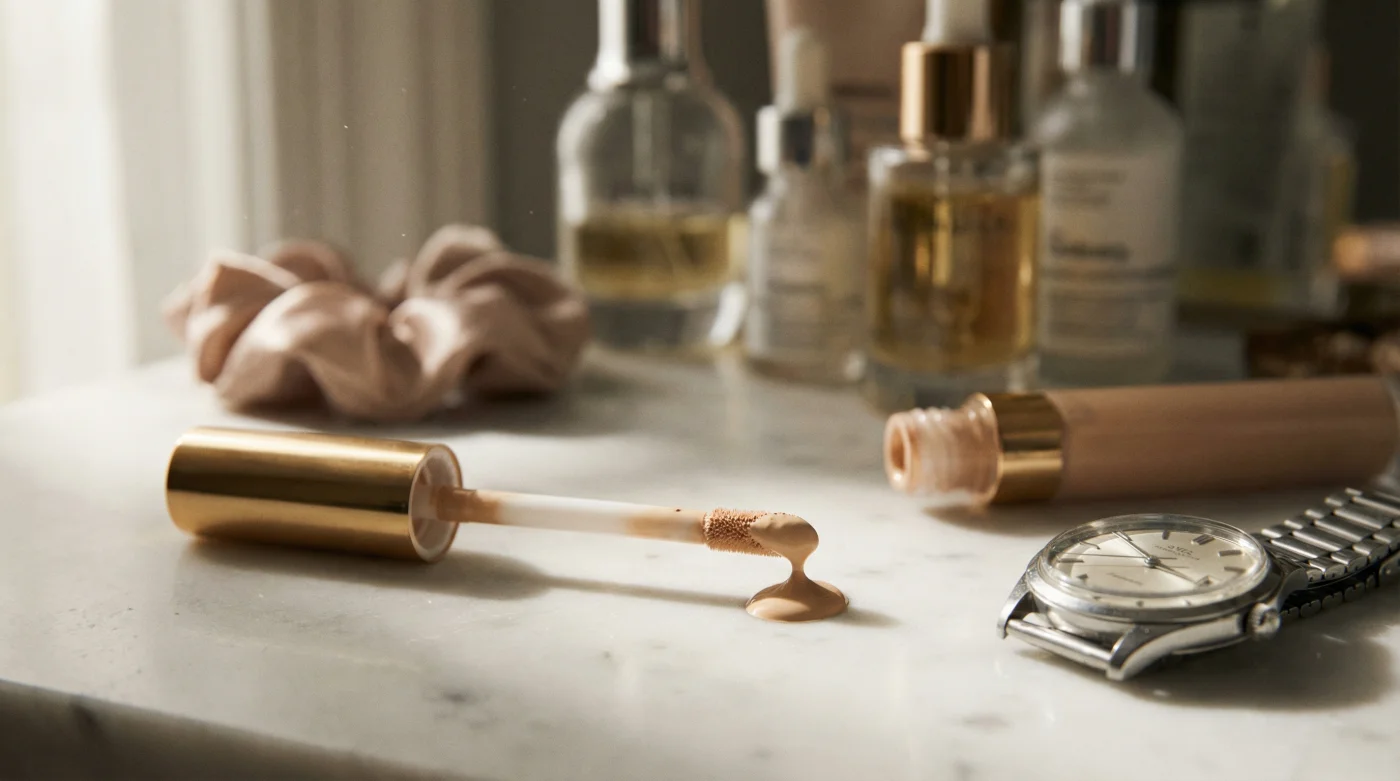
The biting chill of a January morning in Calgary frosts the edges of your bathroom window. You stand in front of the mirror, the harsh overhead lighting catching the faint shadows under your eyes, holding a wand of liquid pigment.
The instinct is an immediate, panicked response. You swipe the wand and grab a damp sponge, furiously tapping the product into the delicate skin before it dries, hoping for a smooth blur.
But by the time you have poured your first cup of dark roast and stepped out into the crisp air, the damage is done. The formula has already settled into the tiny creases of your skin, aging you rather than awakening your features.
You have been conditioned to believe that rapid, wet movement is the only way to avoid patchiness. Yet, the secret to an opaque finish relies on time rather than friction.
The Chemistry of Patience
Think of your morning application like pouring pancake batter onto a hot cast-iron skillet. If you immediately poke and spread the wet batter, you create a thin, uneven mess that burns on the edges and tears in the middle.
Liquid cosmetics operate on a remarkably similar physical principle. When you smear the wet fluid instantly, you shear out the coverage, pushing the raw pigment away from the specific dark circles you actually want to hide.
By forcing the fluid into the microscopic folds of your face while it is still completely wet, you guarantee a structural collapse. The product pools into those tiny valleys as the day wears on, cracking every time you smile.
The alternative is simply letting the formula breathe. A deliberate pause allows the carrier solvents to evaporate slightly, concentrating the raw pigment and creating an impenetrable grip on the skin.
Clara, a 42-year-old principal makeup artist working on television sets in Vancouver, relies on this exact principle. Facing 14-hour shooting days and high-definition cameras, she never touches a freshly dotted under-eye. “The warmth of the skin needs to cook the product,” she explains. She dabs the liquid, then walks away to fill in a brow or organize her brushes, only returning to blend when the formula has oxidized into a tacky, resilient state.
This subtle, controlled oxidation transforms the liquid from a slippery wash into a dense, crease-proof barrier.
Tailoring the Timing to Your Formula
Not all liquids dry at the same rate, and understanding your specific bottle is critical. The ambient climate of your bathroom—whether humid from a shower or bone-dry from winter heating—also plays a subtle role in how fast the solvents evaporate.
For hydration-heavy, water-based formulas, you need the full sixty seconds of waiting. These sheer liquids require more exposure to the ambient air to thicken into meaningful coverage.
Conversely, if you use a matte, quick-dry pigment heavily loaded with silicones, a full minute might lock it down permanently onto the skin. For these volatile mixtures, a thirty-second pause is usually the sweet spot.
Mature skin textures require an even more localized and careful approach. Keep the product strictly to the inner hollows, avoiding the outer corners entirely to prevent heavy textural buildup.
The Slow-Blend Protocol
Relearning this daily habit requires fighting your established muscle memory. It demands a mindful, minimalist sequence that prioritizes exact precision over frantic speed.
By adhering to a mindful sequence—prepping the skin, placing two tiny dots, stepping back, and finally pressing the tacky pigment with a warm ring finger—you build a resilient foundation.
Your tactical toolkit is remarkably simple but requires strict adherence. You want to operate at room temperature, roughly 20 Celsius, using either your bare ring finger or a dense, dry micro-brush for the final pressing motion.
The natural warmth of your own finger acts as a gentle iron, pressing the semi-dry pigment seamlessly into the cellular matrix. This creates a finish that mimics actual human texture, holding firm against movement.
Reclaiming Your Morning Minute
Mastering this minor technical detail does much more than just fix a frustrating cosmetic failure. It forces a small wedge of deliberate stillness into an otherwise chaotic and rushed morning routine.
Instead of rushing through the motions, you are suddenly granted a free minute of absolute pause. You can use those sixty seconds to simply breathe, watching the frost melt on the bathroom windowpane.
When you finally press the oxidized pigment into your skin, it stays exactly where you put it. It will survive the dry heat of your morning commute and the harsh coastal wind on your walk to the office.
You are no longer fighting against the physical limits of your materials. You have finally learned to let the chemistry do the heavy lifting, creating quiet, lasting confidence.
“Time is the most underutilized tool in any cosmetic application; patience yields an opacity that friction simply destroys.”
| Key Point | Detail | Added Value for the Reader |
|---|---|---|
| The 60-Second Wait | Allowing liquid to oxidize before blending. | Prevents midday creasing and fading. |
| Tool Selection | Using a warm finger instead of a damp sponge. | Maintains maximum pigment opacity. |
| Formula Adjustments | 30 seconds for matte, 60 seconds for dewy. | Customizes the technique to your specific products. |
Frequently Asked Questions
Will waiting 60 seconds make the concealer impossible to blend?
Not if you adjust for your formula. Water-based liquids need the full minute, while silicone-heavy mattes only need about 30 seconds to become tacky without locking down completely.Can I still use a damp makeup sponge?
A damp sponge introduces water, which dilutes the pigment you just spent 60 seconds concentrating. Stick to a dry micro-brush or a warm finger for the best results.Does this work for severely dry under-eyes?
Yes, provided your eye cream has fully absorbed first. The oxidation process thickens the pigment so you need less product overall, which is ideal for dry textures.What if I am using a colour corrector underneath?
Apply the corrector, blend it immediately, and let it dry entirely. Then apply your skin-toned liquid and begin your 60-second wait time.How do I know when the product is ready to blend?
The edges of the dot will lose their wet, reflective shine and take on a slightly satin appearance. That visual cue means the carrier solvents have evaporated.