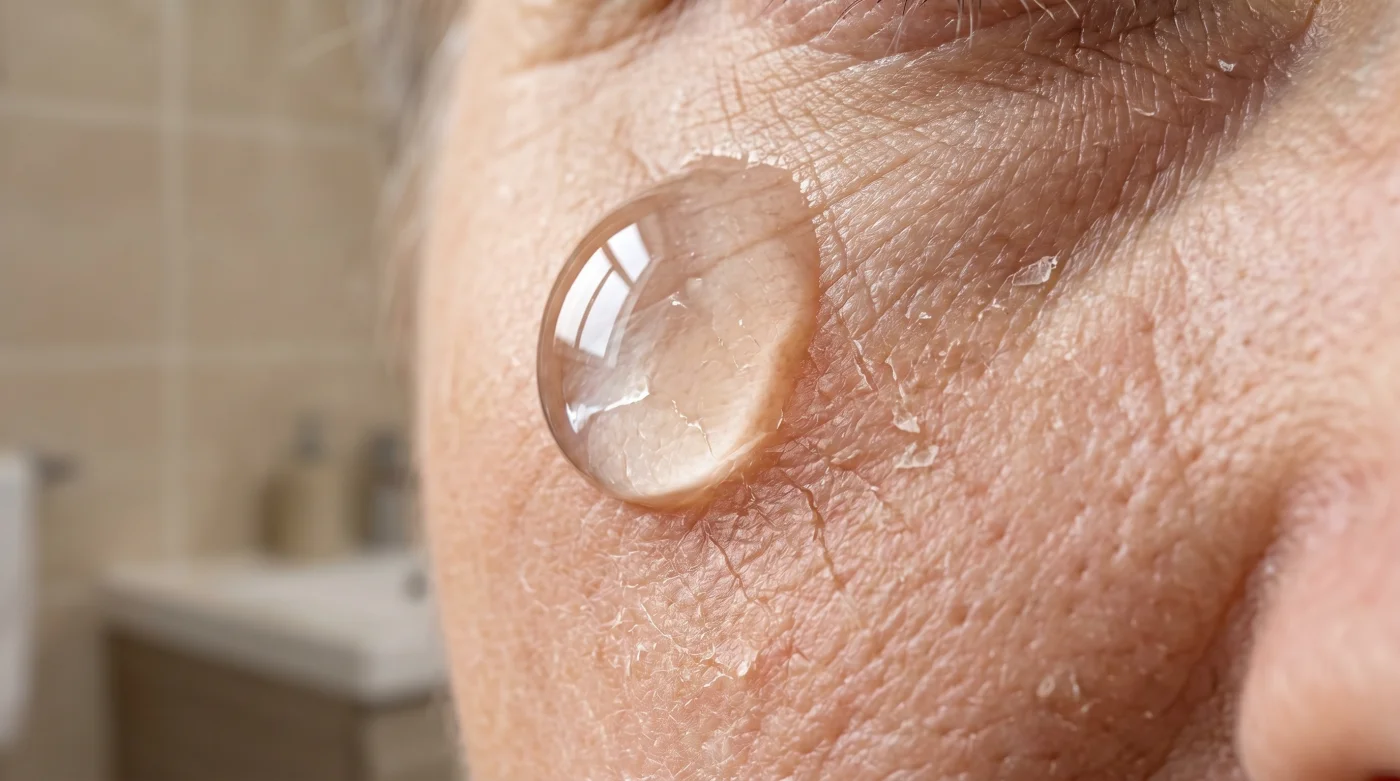
The furnace clicks on, blowing a steady, arid draft across the bedroom. Outside, the morning frost clings stubbornly to the windowpanes, a quiet reminder of the chill waiting beyond the glass. You stand before the bathroom mirror, carefully pressing a few drops of a thick, glassy serum into your cheeks. You pat it down, waiting for that promised plumpness, that youthful bounce.
Instead, ten minutes later, your face feels tight. The lines around your mouth seem sharper, almost drawn in chalk. You applied the most celebrated moisture-binding ingredient on the market, yet your complexion feels like it spent an hour walking head-first into a prairie wind. You naturally assume you just need another layer, so you reach for the dropper again.
This is the silent trap. You are actively accelerating the dehydration you are trying to cure. The harder you work to flood your barrier with these concentrated liquids, the faster that water is pulled from your deeper tissues and evaporated into the dry, heated air of your home.
The Thirsty Sponge Effect
Let’s look at how this molecule actually behaves. Imagine a dried sponge resting on a porcelain plate. If you leave it there, it remains rigid. If you place a damp cloth over it, the sponge swells, drawing the moisture upward. Hyaluronic acid operates on this exact same principle. It is a moisture magnet, capable of holding immense amounts of water, but it has no loyalty to you.
If you apply this magnet to a dry face in a dry room, it must find water somewhere. Because the air around you in a Canadian winter contains almost zero humidity, the serum begins pulling moisture from your deeper tissues, drawing it to the surface where it simply vanishes into the air.
Consider the approach of Claire Vautour, a 56-year-old clinical aesthetician based in Montreal. For years, women would sit in her chair complaining of papery, fragile textures despite spending hundreds on premium hydration regimens. Claire noticed a pattern: they were treating their serums like paint, applying to a dry canvas. She completely banned the practice in her studio. Instead, she taught her clients to think of their face like a raincatcher. The surface must be drenched before the serum even touches the skin.
Tailoring the Moisture Trap
How you handle this shift depends entirely on your daily rhythm and your environment.
For the Minimalist: If your morning routine needs to happen in three minutes flat, you do not need complex toners. Simply refuse to use a towel. After washing your face, let the water sit. Apply your serum while your face is dripping wet, then immediately seal it with heavy cream to lock the reaction in place.
For the Layering Enthusiast: If you enjoy the ritual of skincare, swap the tap water for a thermal water spray or a glycerine-based mist. Create a damp micro-climate between every single layer you apply. Mist, serum, mist, moisturizer. This gives the active molecules an external reservoir to drink from, leaving your internal hydration completely untouched.
For the Winter Walker: If you spend hours outside in temperatures well below zero Celsius, you need to rethink the morning application altogether. A humectant sitting under cold, biting wind can freeze and further compromise a delicate lipid barrier. Shift your hydration focus to the evening, when the environment is controlled, and rely on protective thick lipid barriers before heading out the door.
- The professional application trick that prevents midday makeup melting
- The pantry staple that completely strips product buildup from thinning hair
- The scientifically correct layering rule that stops redness overnight
- Why your expensive morning serum is actually causing hyperpigmentation
- The under-eye technique makeup artists use on women over 40 to erase dark circles
- Women over 50 are ruining their skin barrier with this common hydration mistake
- The professional application trick that prevents midday makeup melting
- The under-eye technique makeup artists use on women over 40 to erase dark circles
- Women over 50 are ruining their skin barrier with this common hydration mistake
- The professional application trick that prevents midday makeup melting
Mindful Application
Repairing a compromised barrier is a matter of sequencing, not spending. The goal is to act as a dam, holding the water tightly against the skin.
This requires a deliberate, almost choreographed approach to your bathroom counter. You are no longer just rubbing liquids onto your face; you are strategically building a sealed micro-environment.
- Water Temperature: Lukewarm only. Hot water strips the natural oils required to hold the moisture down.
- Application Timing: Less than sixty seconds. The window between cleansing and sealing is incredibly brief before evaporation begins.
- The Pressing Technique: Do not rub. Rubbing creates friction and micro-tears. Press the liquid into the skin with the flat palms of your hands, as if you are gently breathing through a pillow.
- The Occlusive Seal: A thick cream or facial oil must be applied immediately over the serum to trap the water beneath it.
The Quieter Confidence
Letting go of the idea that more product equals better results is profoundly freeing. You are often taught to fight your body, to force it into compliance with stronger formulas and heavier layers. But when you step back and observe the mechanics of how your skin naturally wants to function, the friction disappears.
You realize that maintaining a resilient, comfortable complexion is not about buying better, it is about behaving better. It is about working in harmony with your environment, understanding the quiet physics of water and air, and giving your skin exactly what it needs to heal itself. You finally get to stop chasing hydration completely, and simply allow it to stay.
The tightness softens. The fragile, papery feeling is replaced by a sturdy, quiet comfort.
True hydration is never forced into the skin; it is gently invited to stay by closing the door behind it. — Claire Vautour, Clinical Aesthetician
| Key Point | Detail | Added Value for the Reader |
|---|---|---|
| The Wet Canvas Rule | Apply serums only to dripping wet or heavily misted skin. | Prevents the serum from stealing internal moisture, keeping you plump all day. |
| The 60-Second Seal | Apply a heavy cream immediately after your serum step. | Traps the hydration before the dry room air can evaporate it. |
| Winter Timing Shift | Move humectant-heavy routines to the evening. | Protects your lipid barrier from freezing winds when walking outside. |
Frequently Asked Questions
Why does my face feel tighter after using my serum?
When applied to a dry face in a dry room, the serum acts like a sponge, pulling water from your deeper tissues and evaporating it into the air. You are feeling the physical sensation of dehydration.
Can I just mix the serum directly into my moisturizer?
While this saves time, the heavy oils in your moisturizer can block the water-binding molecules from reaching the surface properly. Layering them sequentially gives you much better control.
Is plain tap water okay to use for dampening my face?
Absolutely. If you live in an area with very hard water, you might prefer a basic facial mist, but the temperature matters far more than the source. Keep it lukewarm.
How long should I wait before applying my sealing cream?
Do not wait at all. The goal is to apply your cream while the skin is still slightly damp from the serum, locking that water firmly against your face.
Does this strict rule apply during the humid summer months?
Summer air holds plenty of ambient moisture, so the serum can pull water from the environment rather than your face. However, maintaining the wet-canvas habit ensures consistent, comfortable results year-round.