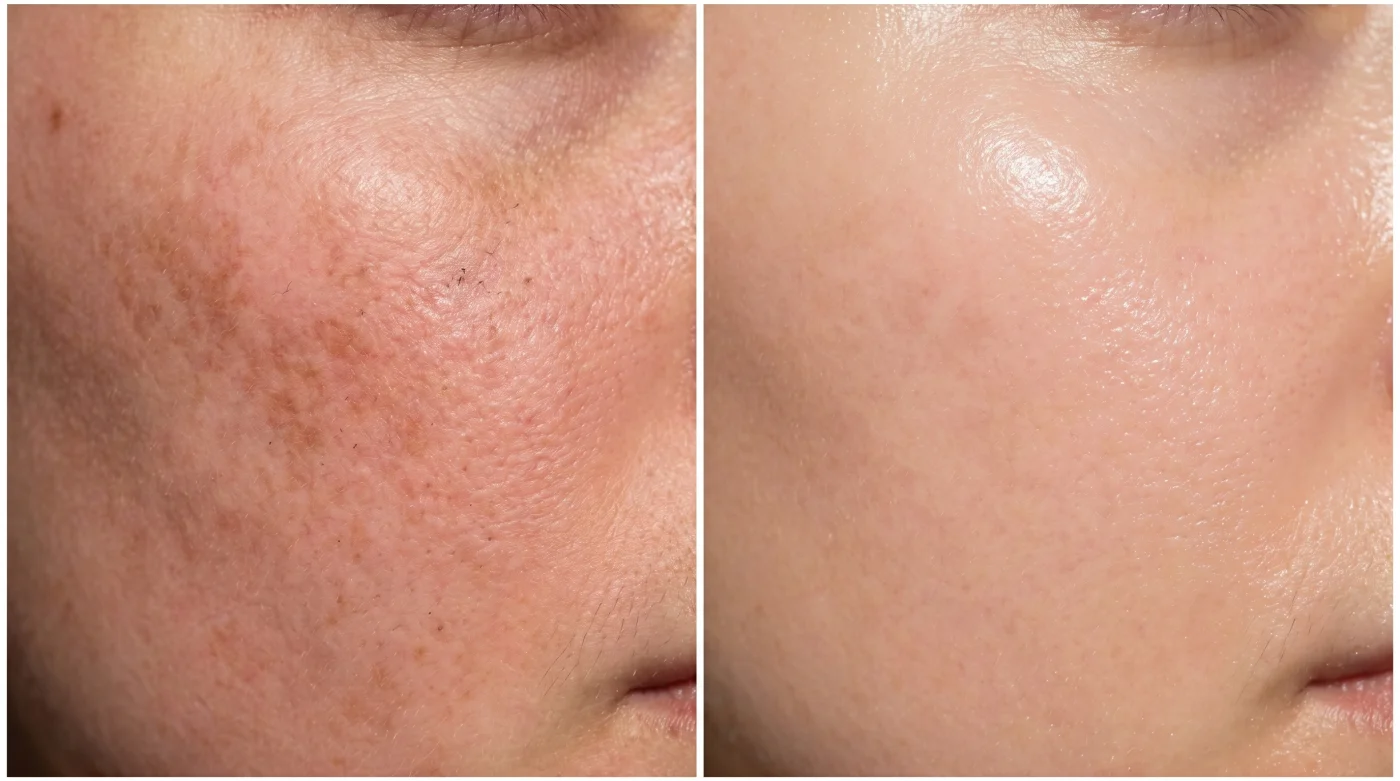
The morning ritual feels almost sacred. You stand before the bathroom mirror in the soft, gray light of a late October morning, the cold tiles beneath your feet grounding you before the day begins. The glass dropper clicks against the rim of the heavy amber bottle. The liquid inside smells faintly metallic, almost smoky—the unmistakable signature of raw ferulic acid. You press three golden drops into your cheeks, breathing through the slight stinging sensation, fully expecting that promised, radiant clearing of your complexion.
Instead, weeks later, you catch your reflection in the harsh fluorescent lighting of a changing room. A subtle shadow has formed along your cheekbones. The stubborn marks you were trying to erase haven’t faded at all; in fact, the spots are getting darker.
It feels like a betrayal of the highest order. You spent the equivalent of a car payment on this tiny bottle, assured by the impeccably dressed sales associate in downtown Vancouver that it was the industry standard for brightening. You followed the directions, applying it religiously every single morning before your coffee finished brewing.
But the very thing you bought to erase hyperpigmentation is quietly feeding it. By misunderstanding how this volatile molecule interacts with sunlight and air, your morning routine has become an unintentional darkening treatment, working actively against you under the midday sun.
The Oxidation Trap on Your Face
We have been taught to treat antioxidants like an invisible forcefield. Years of marketing have convinced us that vitamin C—specifically pure L-ascorbic acid—is an impenetrable armour against the elements, neutralizing free radicals the moment you step outside. But chemistry does not care about marketing promises.
Think of a sliced apple left sitting on the kitchen counter. Once exposed to oxygen and light, the crisp white flesh rapidly browns. Your skin does the same, serving as a warm, highly porous surface for that unstable acid to literally cook upon.
When you apply a pure, unstable ascorbic acid serum and either skip sunscreen or apply a weak, sheer layer of SPF 15, the antioxidant doesn’t just quietly fade away. It oxidizes directly on your face. As ascorbic acid degrades, it converts into a chemical compound called erythrulose. If that name sounds familiar, it should—it is the exact same active ingredient used in self-tanning drops to stain the skin orange.
That oxidized residue settles into your pores, creating a very real, very stubborn stain over your existing pigmentation. Worse, the chemical degradation process actually creates free radical damage, triggering your melanocytes to panic and overproduce melanin, causing deep, stubborn pigment.
Clara Davies, a 42-year-old clinical esthetician operating out of a quiet, sunlit clinic in Montreal, sees this specific damage daily. “Women come in devastated by what they think is sudden, aggressive melasma,” she notes, adjusting the cool steam of her treatment room. “I always audit their morning routine. Nine times out of ten, they are slathering on fifteen per cent raw ascorbic acid, waiting thirty seconds, dabbing on a tinted moisturizer, and walking out into the glaring light. They are essentially rusting their own faces.”
- The under-eye technique makeup artists use on women over 40 to erase dark circles
- Women over 50 are ruining their skin barrier with this common hydration mistake
- Dermatologists reveal why over-the-counter retinol cream accelerates aging after 45
- Women over 50 are applying hyaluronic acid backward and destroying their skin barrier
- Major scandal reveals hidden PFAS chemicals in Canada’s top lash products
- Why luxury skincare brands are quietly removing this filter from their formulas
- The professional application trick that prevents midday makeup melting
- The pantry staple that completely strips product buildup from thinning hair
- The zero-dollar facial technique that mimics professional jawline fillers
- The scientifically correct layering rule that stops redness overnight
Tailoring the Chemistry
You cannot treat a volatile acid like a simple hydrating lotion. To stop the cycle of oxidation and darkening, your approach needs to match your daily environmental exposure and your baseline skin resilience.
For the Commuter
If you spend hours driving or riding the train into the city, those long UVA rays are penetrating the glass, acting as a catalyst for oxidation. You must buffer the acid aggressively. Apply your serum, let it fully dry down until it feels slightly tacky, and seal it with a dedicated, thick layer of SPF 50. You must wait a full ten minutes before walking out the front door.
For the Minimalist
If you want three steps or less in the morning, demands less daily micromanagement must be your priority. Ditch the pure L-ascorbic acid entirely. Swap to a highly stable, oil-soluble derivative like tetrahexyldecyl ascorbate (THD). It requires no agonizing waiting period, does not rust on contact with oxygen, and will not degrade into a self-tanning compound on your cheeks.
For the Sensitized
If your face stings upon application or flushes pink before you even finish your morning routine, your skin barrier is compromised. Ascorbic acid relies on a highly acidic, low pH to penetrate the skin. On a damaged barrier, this causes deep, invisible inflammation. That inflammation triggers post-inflammatory hyperpigmentation. If this is you, stop applying it in the morning immediately and move your antioxidant care to the safety of your evening routine.
The Tactical Morning Protocol
Correcting this chemical error requires a fundamental shift in your morning rhythm. You must learn to treat the application as a precise, deliberate chemical sequence.
Your bathroom routine should feel like a slow, intentional layering of protection, rather than a frantic slapping of wet products. This sequence ensures the active ingredient is absorbed safely, sealed tightly, and prevented from oxidizing in the sunlight.
- Cleanse with a gentle wash and pat dry until the skin feels like bare parchment. Residual tap water shifts the pH of your skin and accelerates the serum’s instability.
- Dispense exactly three drops. Press them firmly into the face and neck with flat, warm palms, rather than rubbing or dragging the fluid.
- Wait until the serum no longer feels cold or wet to the touch—usually around three to four full minutes. Use this time to brush your teeth.
- Apply a generous, two-finger length of high-protection sunscreen. This is an absolute non-negotiable step; it acts as the vault door, locking the antioxidant safely away from UV catalysts.
Finally, respect the fragility of the molecule. Keep your bottle stored in the refrigerator, ideally below 15 degrees Celsius. If the liquid inside ever turns the colour of dark tea, throw it out immediately.
Beyond the Glass Dropper
Giving up the myth of the invincible, miracle serum actually brings a strange, quiet sense of relief. You realize that truly luminous skin is not simply bought at a luxury counter and hurriedly splashed on before work.
It comes from a place of respect. It comes from understanding the quiet biology of your own face, and choosing to work in harmony with the environment rather than fighting a losing chemical battle.
The next time you stand in front of the mirror, holding that cold amber bottle, you will know exactly what is happening beneath the surface. You aren’t just blindly following instructions anymore. You are a steward of your own skin, in complete control of the chemistry.
“Antioxidants are only as effective as the sunscreen you use to protect them from oxidizing on your skin.”
| Key Point | Detail | Added Value for the Reader |
|---|---|---|
| The Erythrulose Effect | Degraded ascorbic acid converts to the active ingredient found in self-tanners. | Explains exactly why skin looks stained and darker, preventing panic over ‘worsening’ hyperpigmentation. |
| The Moisture Rule | Applying to damp skin alters the delicate pH required for the acid to remain stable. | A zero-dollar fix that immediately improves the efficacy and safety of the serum. |
| The Derivative Swap | Using THD ascorbate instead of L-ascorbic acid removes the risk of rapid oxidation. | Offers a stress-free alternative for those who cannot commit to rigorous wait times and thick SPF layers. |
Frequently Asked Questions
Can I just wash the oxidized vitamin C off my face at the end of the day?
While cleansing removes surface debris, the free radical damage and melanocyte stimulation caused by the oxidation process happen deep within the epidermis and cannot be washed away.Is slight yellowing of the serum still safe to use?
A pale champagne hue is generally acceptable, but once it reaches a distinct yellow or orange, it has begun degrading and will likely cause irritation and staining.Does this apply to niacinamide or other brightening serums?
No. Niacinamide and alpha arbutin are incredibly stable and do not carry the same risk of rapid oxidation on the skin’s surface.Can I skip vitamin C entirely if I use a good sunscreen?
Absolutely. Sunscreen is the ultimate preventative tool for hyperpigmentation; antioxidants are a helpful secondary defense, but never mandatory.How long should I wait between my serum and my SPF?
Wait until the serum is completely dry to the touch—typically 3 to 5 minutes—to ensure it has fully absorbed and won’t pill or mix with your UV filters.