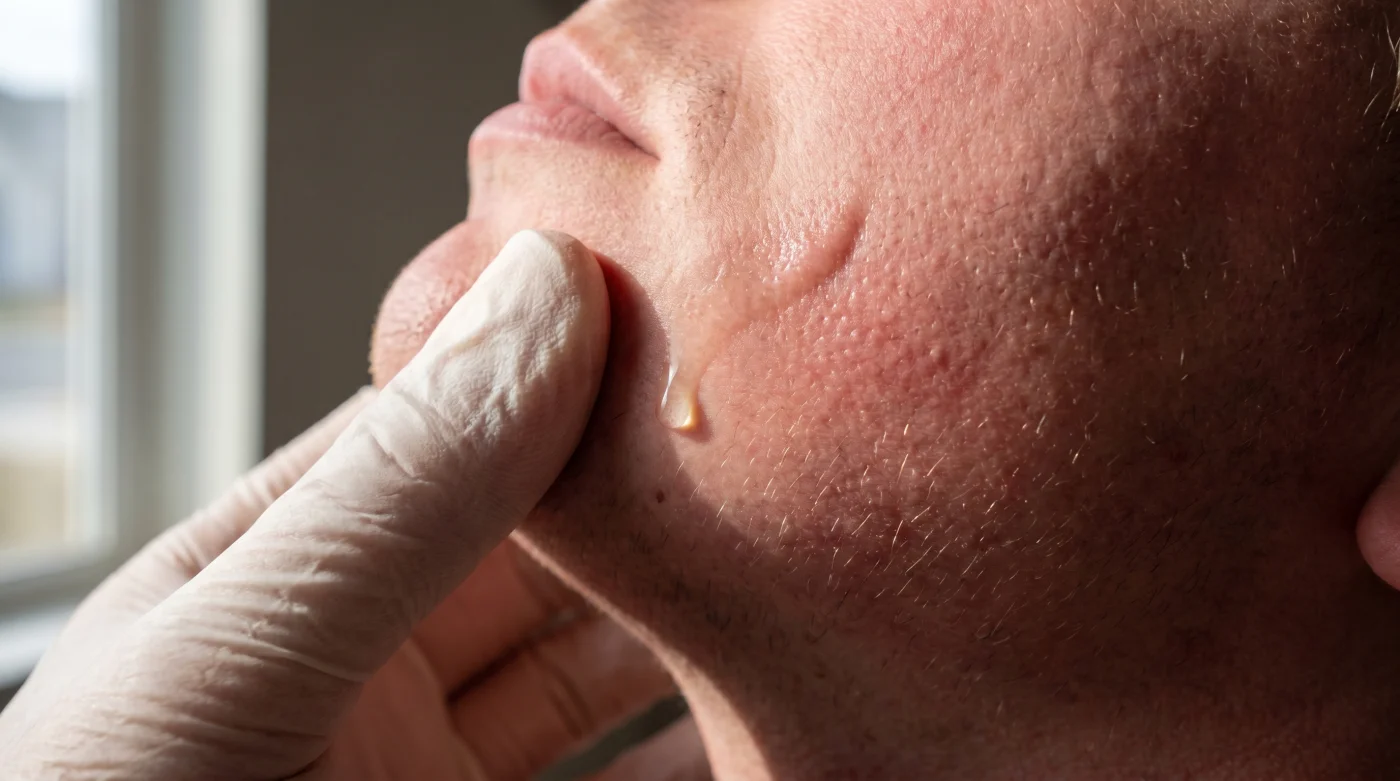
The morning light hitting the bathroom mirror is rarely forgiving. You lean in, tracing the soft, fluid heaviness pooling just beneath your jaw and the corners of your mouth. It feels like overnight, gravity claimed another millimetre. The instinctive reaction is to reach for a heavy, tightening cream or mentally calculate the cost of a clinic visit, imagining the sharp pinch of a needle to restore what feels lost.
But underneath that perceived sagging isn’t just aging skin—it is stagnant water. Your lymphatic system has stalled, trapped by the tension of clenched teeth and a stationary sleep posture. The puffiness dragging down your lower face is mostly fluid, waiting for a physical cue to drain.
Instead of a syringe, imagine the heavy, cool weight of a polished Gua Sha stone resting in your palm. It holds the chill of a bathroom sitting at 18 degrees Celsius, bringing an immediate, grounding shock to your sleep-warm skin. The edge isn’t meant to dig or scrape; it is meant to glide, coaxing the trapped fluid down the neck like sweeping water off a smooth driveway.
This simple friction changes the architecture of your face in under a minute. You can skip the synthetic volume when you manually clear the congestion hiding your natural bone structure.
The Architecture of Your Face
Think of your lower face like a sponge resting on a slow-draining sink. When the pipes—your lymphatic pathways—are constricted by tight neck muscles and poor circulation, the sponge swells with excess fluid. Injecting fillers into a swollen sponge only adds weight, creating that heavy, over-plumped look that inevitably drags the tissue downward over time.
The secret to a lifted jawline is subtraction, rather than addition. By using a Gua Sha stone at specific, almost flat angles, you are physically wringing out the sponge. You are creating a vacuum effect, pulling the stagnation out of the tissue and down the collarbone where the body can naturally flush it away. The hollows of your cheeks and the sharpness of your jaw haven’t vanished; they are simply buried under a microscopic flood.
Consider the approach of Elise, a 52-year-old clinical aesthetician operating out of a quiet studio in Montreal. For two decades, she referred clients to local doctors for injectables the moment they complained of jowls. But after observing the structural fatigue and filler migration in her clients’ faces, she pivoted entirely to manual massage. Elise found that spending just sixty seconds clearing the submental lymph nodes beneath the chin provided a sharper, more immediate contour than a half-syringe of synthetic gel. It became her quiet rebellion against an industry obsessed with freezing and filling.
Adapting the Glide to Your Morning
Not every face carries fluid the same way. The beauty of this manual technique lies in how easily it adapts to the specific way you slept or the stress you carry in your jaw.
- The nightly micellar water mistake aging Canadian women a decade faster
- Dermatologists reveal why over-the-counter retinol cream accelerates aging after 45
- Women over 50 are applying hyaluronic acid backward and destroying their skin barrier
- Major scandal reveals hidden PFAS chemicals in Canada’s top lash products
- Why luxury skincare brands are quietly removing this filter from their formulas
- The professional application trick that prevents midday makeup melting
- The pantry staple that completely strips product buildup from thinning hair
- The zero-dollar facial technique that mimics professional jawline fillers
- The scientifically correct layering rule that stops redness overnight
- Why your expensive morning serum is actually causing hyperpigmentation
For the TMJ Clencher, grinding your teeth through the night leaves you with inflamed masseter muscle barriers acting like dams blocking fluid from draining. Focus the stone’s notched edge right at the corner of your jaw, using tiny, vibrating movements to release the muscle before sweeping down the neck.
For the Side Sleeper, pressing into a pillow forces fluid to accumulate unevenly on one side of your face. You will need to spend an extra thirty seconds on your dominant sleeping side, creating a physical pathway for the asymmetrical swelling to escape by using long, flat sweeps from the corner of the mouth directly to the earlobe.
For the Rushed Commuter, when you have exactly one minute before running out the door, skip the cheeks entirely. Focus solely on the jawline and the sides of the neck. Clearing the main drainage pathways is enough to pull the fluid down from the rest of the face passively as you go about your day.
The Sixty-Second Lift Protocol
The most common error with a Gua Sha stone is treating it like a chisel. You are not trying to carve bone; you are coaxing water beneath skin. Hold the stone almost entirely flat against your face, breathing through the movement. The pressure should be so light it barely stretches the surface, moving with the slow, deliberate pace of a second hand ticking on a clock.
- Apply three drops of facial oil to create a completely frictionless surface.
- Place the notched edge of the stone at the centre of your chin.
- Keep the tool flat, sweeping along the jawbone to the earlobe.
- Wiggle the stone slightly at the ear to stimulate the lymph node.
- Turn the stone flat and sweep down the side of the neck to the collarbone.
Tactical Toolkit:
- Angle: 15 degrees (almost touching the skin).
- Pressure: The weight of a nickel.
- Pace: Three slow seconds per sweep.
- Repetitions: Five sweeps per side.
Reclaiming Your Reflection
Relying on expensive appointments to feel comfortable in your own skin creates a quiet dependency. You start looking at your face as a series of flaws that can only be fixed by a professional holding a syringe.
But learning the geography of your own face changes that dynamic. When you understand that the morning heaviness involves managing a mechanical issue—a simple build-up of fluid—you stop fearing the aging process and start handling it with quiet, daily rituals.
This sixty-second habit is a grounding act of self-reliance. You are no longer outsourcing your confidence. You are simply clearing away the noise, revealing the natural, sculpted foundation that was always sitting just beneath the surface.
True facial contouring doesn’t come from a needle; it comes from understanding the fluid dynamics of your own skin.
| Key Point | Detail | Added Value for the Reader |
|---|---|---|
| Injectable Fillers | Adds synthetic volume to mask sagging tissue. | Requires ongoing expense and risks long-term facial heaviness. |
| Topical Creams | Hydrates the surface but cannot move trapped fluid. | Provides surface-level comfort without structural change. |
| Gua Sha Stone | Mechanically drains lymphatic fluid and reduces swelling. | Offers immediate, zero-dollar contouring you control yourself. |
Common Gua Sha Questions
Can I use Gua Sha on dry skin?
Never. The skin must have slip from a facial oil or heavy serum; otherwise, you risk pulling the tissue and causing micro-tears.How often should I do this?
Once a day is plenty. The morning is best because it clears the fluid that accumulated while you were lying horizontally overnight.Does the stone material matter?
Not mechanically. Whether it is rose quartz, jade, or stainless steel, the shape and the cooling effect are what do the actual work.Why do I break out after using it?
You are likely pressing too hard and pushing bacteria into your pores, or you aren’t washing the stone with soap after each use.How long until I see results?
You will notice a reduction in puffiness immediately after the first sixty seconds, with cumulative muscle-relaxing benefits showing after a few weeks.