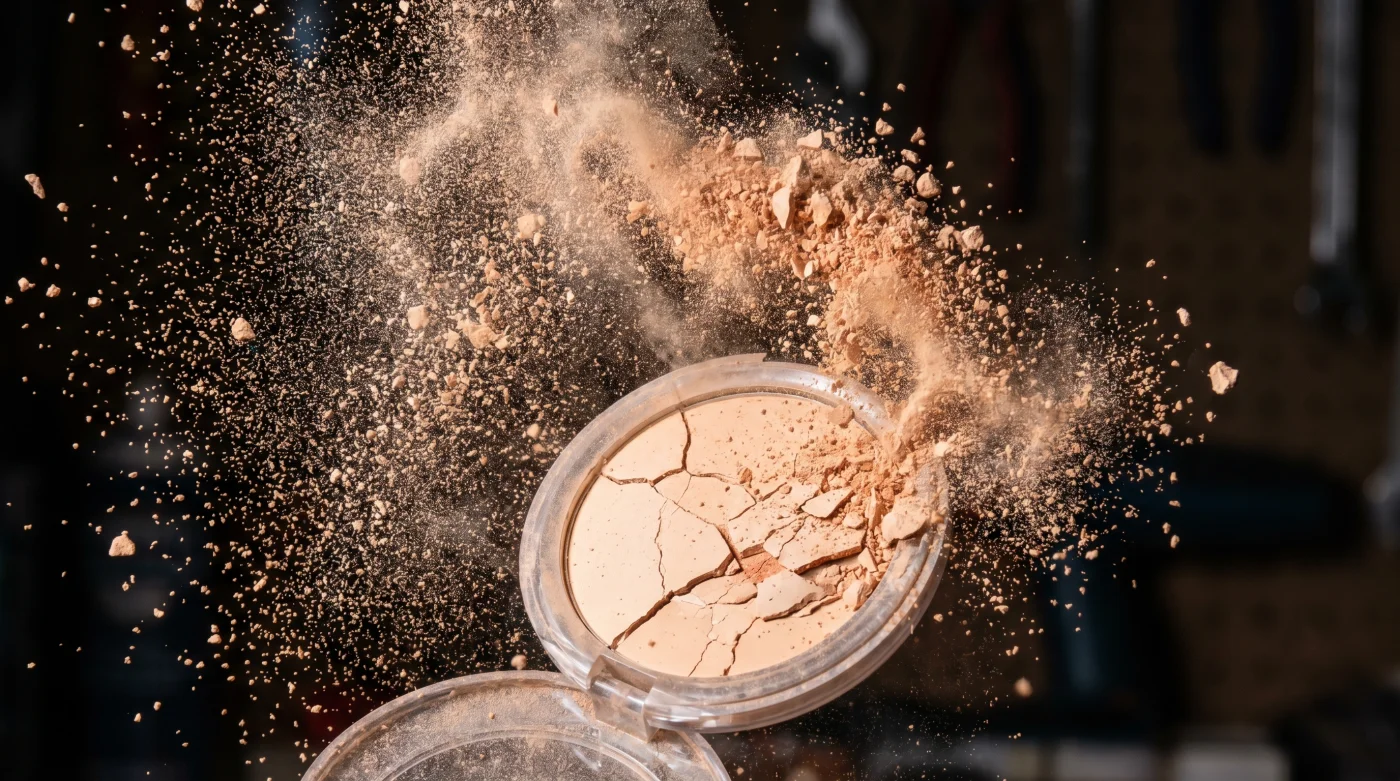
Imagine the soft puff of a powder brush tapping against the edge of a porcelain sink. The fine mist suspended in the bathroom light—a ritual passed down from your grandmother’s vanity to your own morning rush.
For decades, that silky, mattifying finish was a non-negotiable step. You likely never questioned the soft, chalky substance settling over your skin. It was just the quiet anchor of morning routines, setting concealer and smoothing the canvas before stepping out into a crisp Calgary breeze.
But the air in cosmetic laboratories across the country has changed. What was once the unquestioned backbone of high-end compacts and budget baking powders is now the centre of a massive regulatory shift. Health Canada has quietly tightened the grip on an everyday makeup ingredient sitting in your drawer right now: talc powder.
The reality of this legacy mineral—the invisible force behind your favourite blurring effect—is fracturing. As regulators redraw safety boundaries, the cosmetic industry is reacting in real-time, pulling legacy formulas and scrambling to rebuild top-selling palettes from scratch.
The Invisible Dust Settling on the Industry
Think of traditional cosmetic formulation like baking a delicate pastry. Talc was the flour. It provided the slip, the spread, and the bulk. It absorbed oil beautifully and cost pennies to mine. But we are now learning that relying on it was like building a flawless façade with compromised mortar.
The pivot isn’t just about avoiding a single mineral; it’s about fundamentally rethinking how we finish our skin. The safety threshold has moved. This isn’t merely a suggestion—it’s a mandated erasure of legacy formulas that forces a total overhaul of the powders you trust.
Meet Dr. Aris Thorne, a 52-year-old toxicologist who spent the last fifteen years evaluating cosmetic particulate matter in Toronto. He notes that the conversation around talc often misses the nuance of cross-contamination. “We aren’t just looking at the mineral in isolation anymore,” he explains, adjusting a set of microscopic slides. “We are measuring the invisible geological neighbours it brings into the compact. Health Canada’s recent restrictions acknowledge that the risk of inhaling these trace contaminants during a daily cosmetic application is simply no longer an acceptable margin.”
The sweeping changes mean the market is rapidly dividing. Depending on your routine, the impact hits your makeup bag differently.
- Why luxury skincare brands are quietly removing this filter from their formulas
- The professional application trick that prevents midday makeup melting
- The pantry staple that completely strips product buildup from thinning hair
- The zero-dollar facial technique that mimics professional jawline fillers
- The scientifically correct layering rule that stops redness overnight
- Why your expensive morning serum is actually causing hyperpigmentation
- The under-eye technique makeup artists use on women over 40 to erase dark circles
- Major luxury brands are scrambling to remove talc powder after new safety findings
- Health Canada quiet restriction on popular chemical exfoliants sparks panic
- The application error making your mineral sunscreen highlight every fine line
How This Affects Your Vanity
For the Heavy Baker: If your routine relies on pressing thick layers of loose powder under the eyes and brushing away the excess, you are inhaling the most particulate matter. The new regulations mean your favourite loose settings will likely be discontinued and replaced with heavier, silica-based alternatives that behave entirely differently on the skin.
For the Pressed Compact Loyalist: Carrying a mirrored touch-up powder in your purse has been standard practice for decades. These compacts are being quietly reformulated with mica and cornstarch. You might notice your newly purchased refill hitting the pan faster, or lacking that familiar, velvet-like grip on an oily T-zone.
For the Cream Converter: If you have already begun swapping powders for cream blushes and liquid bronzers, you are ahead of the curve. The industry is leaning heavily into liquid formulations specifically because they bypass the inhalation risks of dry minerals entirely.
Navigating the Reformulated Landscape
Replacing talc requires a change in physical application. You cannot treat a modern, mica or cornstarch-based powder with the heavy hand of the past.
Alternative ingredients absorb moisture at different rates. If you apply them the exact same way, you will end up with a cakey, separated mess by midday. Here is your tactical toolkit for adapting to the new formulas:
- The Press, Don’t Sweep Method: Instead of buffing powder in circles, use a slightly damp sponge to press the new formulations into the skin. This melts starches seamlessly.
- Mind the Temperature: Silica-based powders perform best when your foundation has cooled to skin temperature (around 32 degrees Celsius). Wait two full minutes after applying liquid base.
- Tool Downsizing: Swap your oversized, fluffy powder brush for a smaller, tapered setting brush. Precision prevents excess airborne particles.
A Cleaner Canvas
Having to audit your own cosmetics feels like an unwanted chore. Yet, this regulatory boundary actually forces us to curate a healthier baseline for our skin.
By stepping away from the habitual dusting of legacy minerals, you are invited to appreciate the natural texture of your complexion. The end of the talc era isn’t a loss; it is a push toward better science, safer lungs, and a more mindful approach to what we allow onto our faces.
“A beautiful finish should never require us to compromise the air we breathe. True cosmetic innovation lies in removing the unseen risks.”
| Key Point | Detail | Added Value for the Reader |
|---|---|---|
| Regulatory Shift | Health Canada is enforcing stricter limits on talc in loose cosmetics to prevent inhalation risks. | Empowers you to check your current products and understand why favourites might be disappearing. |
| Formulation Changes | Brands are swapping talc for mica, silica, and starches, altering the texture of powders. | Prepares you for the physical differences in how new products will feel and perform. |
| Application Pivot | New ingredients require pressing with damp sponges rather than sweeping with large dry brushes. | Saves you from the frustration of cakey makeup when using the newly formulated replacements. |
Frequently Asked Questions
Is all talc currently illegal to own?
No. The restrictions target the manufacturing and formulation standards going forward, specifically regarding inhalation risks in loose powders. You don’t need to throw out your entire drawer, but you should be mindful of how much loose powder you are breathing in.Why is cornstarch suddenly in my makeup?
Cornstarch is an inexpensive, highly absorbent natural polymer. It mimics the oil-controlling properties of legacy minerals without carrying the same geological contamination risks.Will these new formulas break me out?
It depends on your skin. Some people find starch-based powders more likely to trap bacteria if not washed off properly. Double cleansing at night becomes non-negotiable.Are cream products a safer alternative?
Yes, from an inhalation perspective. Liquid and cream products do not create airborne particles, making them entirely exempt from these specific respiratory concerns.How do I know if my powder has been reformulated?
Check the back of your new compact. If talc is no longer the first ingredient listed—often replaced by ‘Mica’ or ‘Silica’—you are holding the updated version.