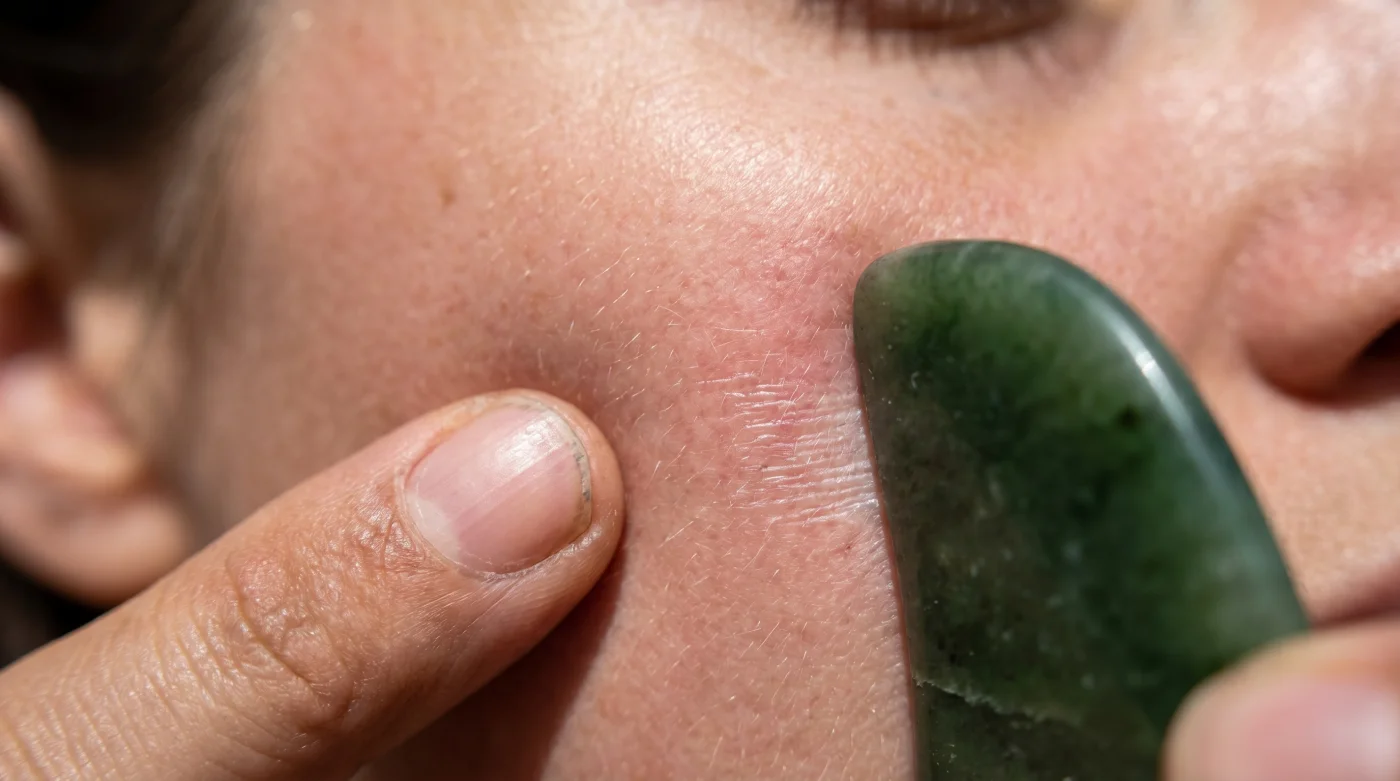
You stand at the bathroom mirror, the winter light catching the frosted edges of the glass. The chilled rose quartz feels heavy and promising in your hand, carrying the quiet weight of a morning ritual. You press the stone to your jawline, feeling the cool shock of 15 Celsius against your sleep-warm skin.
Online, you see people dragging these colourful slabs across their cheeks with force, leaving angry red streaks behind. They pull the skin taut by sheer friction, mimicking an aggressive sanding process. This heavy-handed scraping trend threatens the very foundation of your facial structure.
The truth of the practice is far quieter. The magic of facial manipulation does not live in how hard you press, but in how thoughtfully you support the surrounding tissue. Without support, you are simply tugging at delicate biological threads, hoping they will naturally snap back into place.
Failing to hold the skin taut at the base of your movement leads to a silent, microscopic disaster. Over the span of a few miles of cumulative movement across your lifetime, the delicate facial ligaments stretch, creating the exact drooping effect you originally intended to fix.
The Fabric of Your Face
Think of your fascia and connective tissue like a damp, vintage silk blouse resting on a wooden drying rack. If you drag a heavy iron across the fabric without pinning down the corners, the material bunches, warps, and eventually frays at the seams.
Your face relies on a similar microscopic scaffolding to hold everything high and tight against the bone. When you pull a stone across an unsupported cheek, you tear the delicate fascia, causing micro-traumas that compromise your natural elasticity over time.
The perspective shift here is profound. We have been conditioned to believe that visible friction equals visible results, but the professional reality demands the exact opposite. You must learn to brace the canvas before you apply the brush.
By introducing a simple, non-negotiable two-finger hold, a mundane morning routine transforms into a highly protective, zero-dollar glow. You mimic the structural support of costly fillers simply by preserving the integrity of your own ligaments.
The Art of the Anchor
Clara, a 48-year-old aesthetician working out of a sunlit studio in downtown Toronto, spends her days correcting the damage of overzealous home treatments. She watches clients arrive with broken capillaries and prematurely lax skin pooling near the chin. Her corrective technique relies on nothing but her own hands and a deep respect for human anatomy.
“You have to treat the tissue like you are breathing through a pillow,” she explains, placing two firm fingers right at the centre of the chin. Only then does she begin to move the flat edge of the tool, ensuring the skin remains perfectly still behind the glide.
- Neck cream application techniques are pulling your delicate skin downward
- Salicylic acid spot treatments permanently darken acne scars on application
- Makeup sponges actually remove coverage when used completely soaking wet
- Magnesium supplements clear hormonal acne faster than topical spot treatments
- Liquid foundation accelerates visible aging for women over forty years
- Rice water scalp treatments are destroying your natural hair elasticity
- Vitamin C serum works backward if applied after this product
- Oliver Bonk hockey hair revival sparks a massive salon styling trend.
- Snail mucin allergies are silently causing your sudden adult cystic breakout.
- Dianna Russini camera makeup routine uses a drugstore primer for sweatproof foundation.
Adapting the Glide for Your Face
Not every face demands the exact same pressure, but every face demands an anchor. Customizing your approach ensures that you nurture your natural barrier rather than breaking it down.
For the Fragile Barrier, characterized by thin tissue or reactivity, the stone should barely skim the surface of your facial oil. Your anchoring fingers must hold the base with extreme care, preventing any vascular damage while still encouraging gentle fluid drainage.
For the Morning Depuffer, the goal is shifting stagnant water retention rather than deeply manipulating muscle. Your focus rests on guiding fluid toward the lymph nodes at the collarbone.
Here, the anchor sits firmly at the hairline or the base of the neck, creating a taught runway. The stone glides like water, sweeping away morning puffiness without ever pulling the structural ligaments beneath the surface.
Mindful Application
Mastering this technique requires slowing down and paying attention to the physical feedback under your fingertips. The process is minimalist, asking for nothing more than a slippery medium and a grounded stance.
Begin by warming three drops of oil between your palms and pressing it gently into your face and neck. Ensure a frictionless, glassy surface so the tool never catches or drags on dry patches.
- Place your non-dominant index and middle fingers firmly at the starting point (e.g., the chin).
- Keep the tool nearly flat against your face, at a 15-degree angle.
- Pull the stone away from your anchor fingers with feather-light pressure.
- Stop at the hairline or ear, give a slight wiggle to release tension, and lift off.
Tactical Toolkit:
- Optimal stone temperature: 20 Celsius for muscle tension, 5 Celsius for severe puffiness.
- Speed: Two inches per second.
- Duration: Three to five minutes, maximum.
Remember that you are not sanding a piece of wood; you are coaxing fluid through a delicate maze. The pressure should tremble slightly, mimicking the lightest touch of a feather rather than the drag of a plow.
A Quieter Approach to Routine
When you strip away the aggressive marketing and the frantic energy of online tutorials, facial massage becomes an act of profound self-preservation. You stop fighting your face and start working in harmony with its natural boundaries.
Holding the skin steady is a physical metaphor for grounding yourself before stepping out into the world. This small, deliberate pause prevents damage and cultivates a lasting, internal resilience.
You place the stone back on the porcelain sink. The redness is absent, replaced by a soft, flushed warmth that speaks of health, not trauma. You have learned the difference between forcing a result and supporting a system.
“True structural integrity comes from supporting the foundation before you attempt to move the surface.”
| Key Point | Detail | Added Value for the Reader |
|---|---|---|
| The Two-Finger Anchor | Pinning the skin at the start of the glide. | Prevents micro-tears and preserves long-term skin elasticity. |
| The 15-Degree Angle | Keeping the stone almost flat against the skin. | Maximizes surface contact for lymphatic drainage without bruising. |
| Glassy Lubrication | Using enough oil to eliminate all physical friction. | Protects the delicate moisture barrier from physical exfoliation. |
Questions You Might Have
Does holding the skin really prevent wrinkles?
It prevents mechanical stretching of your fascia, which is a major contributor to premature laxity when using massage tools improperly.Can I use a dry face if I am prone to breakouts?
No, friction is the enemy. Use a non-comedogenic squalane or simply perform the massage while cleansing with a slippery balm.How hard should I press to see results?
The weight of a nickel. Lymphatic fluid sits just beneath the surface; pressing hard bypasses the lymph and bruises the muscle.What if my skin still turns red?
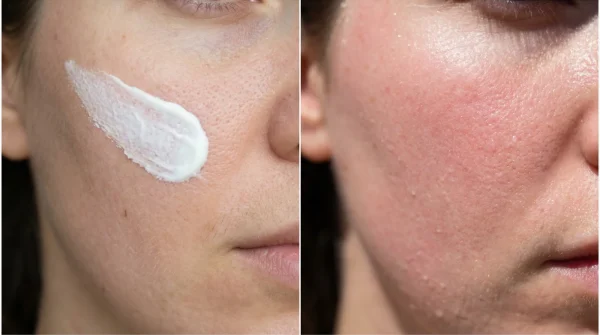
A mild pink flush indicates healthy blood flow. Angry red streaks mean you are causing trauma and need to lighten your touch and increase your oil.Do I need an expensive stone to do this correctly?
Not at all. The magic is in the anchoring technique, not the crystal. A clean ceramic spoon works just as beautifully when supported properly.