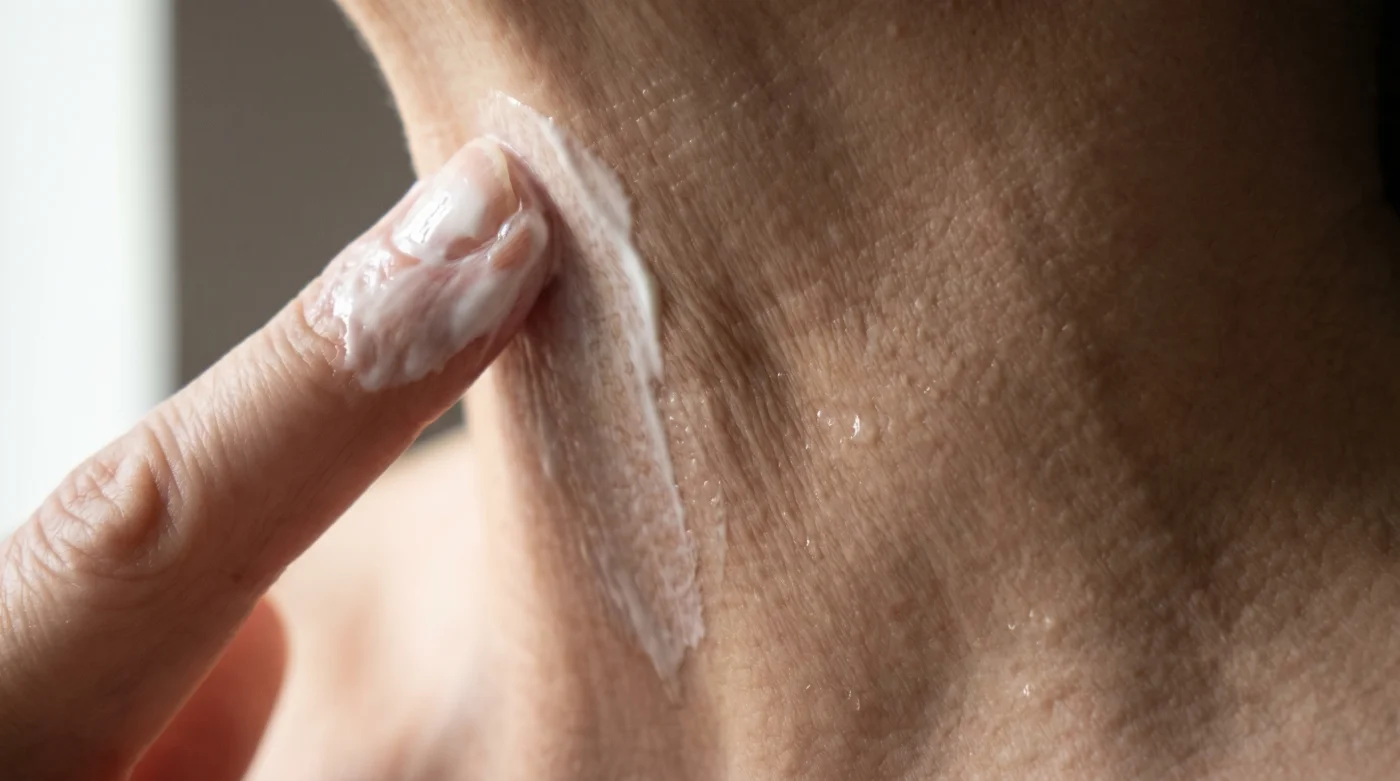
The hum of the bathroom fan creates a quiet white noise. The day is finally over. The bathroom mirror is still fogged from the warm shower. You unscrew the heavy glass jar, the faint scent of oat milk and shea butter filling the small space. You scoop out a modest pearl of neck cream, warming it briefly between your palms.
You tilt your head back slightly, pressing your hands under your chin, and drag the rich formula firmly downward to your collarbone. It feels entirely instinctual. Gravity pulls the water down the drain; your hands follow the same familiar, downward path. It is a seamless, comforting part of your evening wind-down.
But this deeply ingrained physical habit is quietly betraying you. You are mechanically working against the very architecture of your throat. Every downward sweep stretches a fragile web of tissue that completely lacks the resilient, supportive fat pads found on your cheeks.
We often treat this area as a hurried afterthought, a quick downward swipe to simply finish off the face routine. Yet, the skin here behaves much more like the delicate, papery tissue around your eyelids. Treating it with heavy downward strokes is creating the exact sagging you are diligently trying to prevent.
The Gravity of the Platysma
Think of the platysma muscle like a finely woven silk scarf draped gently from your collarbone up over your jawline. It is incredibly thin, completely disconnected from the strong skeletal anchoring that keeps your facial muscles firm and taught.
When you massage your heavy creams downward night after night, you are dragging that delicate silk against its natural grain. Over time, the microscopic fibres lose their structural tension. The fabric begins to drape loosely, unable to snap back into its original, crisp place.
The shift in mechanical logic here is incredibly simple, yet profoundly protective. Your delicate throat does not need aggressive rubbing or downward friction; it requires an upward, supportive scaffolding. By reversing your daily motion, you transform a mundane bathroom chore into an active, structural defence.
Elise, a 52-year-old dermal therapist working in downtown Toronto, noticed this specific mechanical error repeatedly over two decades in her clinical treatment room. She watched clients who were meticulous about softly patting their eye creams completely abandon that gentle touch below the jaw. They would invest hundreds of dollars in premium, peptide-rich balms, only to vigorously pull the product down towards their chest, rubbing the skin as if soothing a sore shoulder muscle. ‘You are ironing the creases in,’ she would tell them gently, guiding their hands to scoop softly upwards from the clavicle to the chin, teaching them to treat the neck skin like a delicate soufflé that must not fall.
Adjustment Layers for Your Routine
Not every formula interacts with the skin the exact same way. The specific texture of your chosen product dictates how your hands should mechanically move. Listen to your skin’s resistance.
- Salicylic acid spot treatments permanently darken acne scars on application
- Makeup sponges actually remove coverage when used completely soaking wet
- Magnesium supplements clear hormonal acne faster than topical spot treatments
- Liquid foundation accelerates visible aging for women over forty years
- Rice water scalp treatments are destroying your natural hair elasticity
- Vitamin C serum works backward if applied after this product
- Oliver Bonk hockey hair revival sparks a massive salon styling trend.
- Snail mucin allergies are silently causing your sudden adult cystic breakout.
- Dianna Russini camera makeup routine uses a drugstore primer for sweatproof foundation.
- Peptide lip treatments cause permanent volume loss when used daily.
For the Lightweight Hydrator
If you use a thin, watery gel or a lightweight serum, your focus is entirely on rapid absorption without causing surface friction. Light, upward tapping motions prevent the product from dragging across the skin. You want to flutter your fingertips upwards, starting at the base of the throat and moving up, like rain falling in reverse.
For the Rich, Restorative Balm
Thicker preparations, often laden with ceramides and dense plant butters, require body heat to melt properly into the lipid barrier. Press the dense balm firmly into your palms first. Do not force the glide. Use the full flat of your hand to gently press and roll upwards, allowing the ambient warmth of your skin to soften the cream before you attempt to move it across the delicate platysma.
For the Sun-Exposed or Reactive Neck
If your neck shows signs of redness, rough texture, or hyperpigmentation from years spent outdoors without a supportive collar, physical friction is your absolute enemy. Opt for a strict press-and-release method. Press the cream in gently with flat palms, starting at the base of the neck and slowly walking your hands up to the jawline without swiping, sliding, or rubbing at all.
The Upward Scaffolding Technique
Retraining your hands takes a few consecutive days of conscious effort. You are actively rewriting years of incorrect muscle memory. Approach the bathroom mirror with mindful intention rather than rushing.
Stand straight and tilt your chin just slightly toward the ceiling. Feel the natural tension return to the front of your throat before your hands even make physical contact with your skin.
- Warm a blueberry-sized amount of cream between the pads of your fingers until it turns nearly transparent and spreads easily.
- Place your alternating hands at the base of your throat, resting just above the bony ridge of the collarbone.
- Sweep upward using a feather-light touch, alternating your left and right hands in a fluid, continuous motion, ending the stroke gently just under the jawbone.
- Once at the jawline, sweep outwards towards the ears to encourage natural lymphatic clearing without pulling the skin back down towards the chest.
The Tactical Toolkit:
- Temperature: Ensure your hands are comfortably warm (ideally around 20 Celsius). Cold fingers cause the neck muscles to instinctively tense up and pull downward in defence.
- Timing: Dedicate exactly 30 seconds to this upward sweeping motion. No more, no less. Over-manipulation leads to irritation.
- Pressure: Imagine smoothing a delicate piece of wet tissue paper over a balloon without tearing it. That is the absolute maximum pressure allowed.
Rebuilding the Scaffolding
Mastering this small, highly specific physical motion does far more than mathematically protect the delicate platysma muscle. It forces you to pause your evening routine. It demands gentle, physical presence.
You are no longer rushing through a nighttime chore, blindly dragging your skin downward in a race to turn off the lights and get into bed. You are building upward. You are offering structural support to an area that physically works to hold your head high all day long.
The neck holds our daily postural tension, our voice, and our physical vulnerability. By treating it with the upward grace and mechanical respect it actually requires, you preserve its fragile architecture while granting yourself a deeply necessary moment of quiet care at the end of a long day.
The direction of your daily physical touch holds exponentially more power over your skin’s structural future than the price tag printed on your jar.
| Key Point | Detail | Added Value for the Reader |
|---|---|---|
| Downward Dragging | Stretches the unsupported, delicate platysma muscle over time. | Avoids actively accelerating the visible mechanical aging process. |
| Upward Sweeping | Works physically with the natural upward grain of the muscle fibres. | Provides a daily, mild structural lift and preserves elasticity. |
| Temperature Control | Applying with hands at 20 Celsius prevents muscle tensing. | Ensures smooth, friction-free absorption without resistance. |
Frequently Asked Questions
Does downward massage really cause permanent sagging? Over years of daily repetition, downward traction on the paper-thin platysma muscle weakens the underlying connective tissue, absolutely contributing to mechanical laxity.
Should I apply my face serum to my neck as well? Yes, but you must apply it using the same gentle upward tapping or sweeping motions, never dragging it down from the jawline to the chest.
How much physical pressure is safe for the neck? Only enough pressure to move the topical cream, not the muscle underneath. Think of smoothing wet tissue paper over a balloon without tearing it.
Can I use a heavy stone roller on my neck? Yes, but strictly roll in an upward direction. Pick the roller entirely up off the skin at the jawline and bring it back down through the air to the collarbone to start the next stroke.
How long until I see a visible difference from upward application? While it will not reverse existing severe laxity overnight, you will stop contributing to further mechanical sagging immediately, preserving the collagen you currently have.